One consistent architecture across Internet, TV, Voice, and billing, all launched on time.
A service provider launched Internet, TV, and Voice on one integrated architecture instead of a vendor per technology. On time, one accountable team, lower cost.

A service provider launching Internet, TV, and Voice needed all three, plus billing, to work as one system from day one, or the launch would slip. Charter set a single architecture across every vendor and stayed on it through testing and cutover. The provider launched on time, with one team accountable for the whole result, at a cost significantly lower than a vendor-per-technology approach.
At a glance
- Internet, TV, and Voice launched on time on one integrated architecture
- 402.5 hours of coordinated design, build, and deployment
- One accountable team instead of a separate vendor per technology domain
Business challenge
For a service provider launching a new Subscriber Management offering, going live meant more than switching services on. Internet, TV, and Voice each depend on different manufacturers' technology, and if those pieces do not work as one system from day one, the launch slips and the service does not hold up for subscribers.
Delivering that as one resilient, end-to-end service meant integrating it all, plusbilling, rather than engaging a separate vendor for each domain, which would have madethe rollout difficult and complex to manage.
What Charter delivered
Charter's multi-domain service capabilities covered the full range of technologies the service required. The team set the architecture to deliver the performance every key technology needed, and stayed in real-time collaboration as testing progressed to keep the deployment on track.
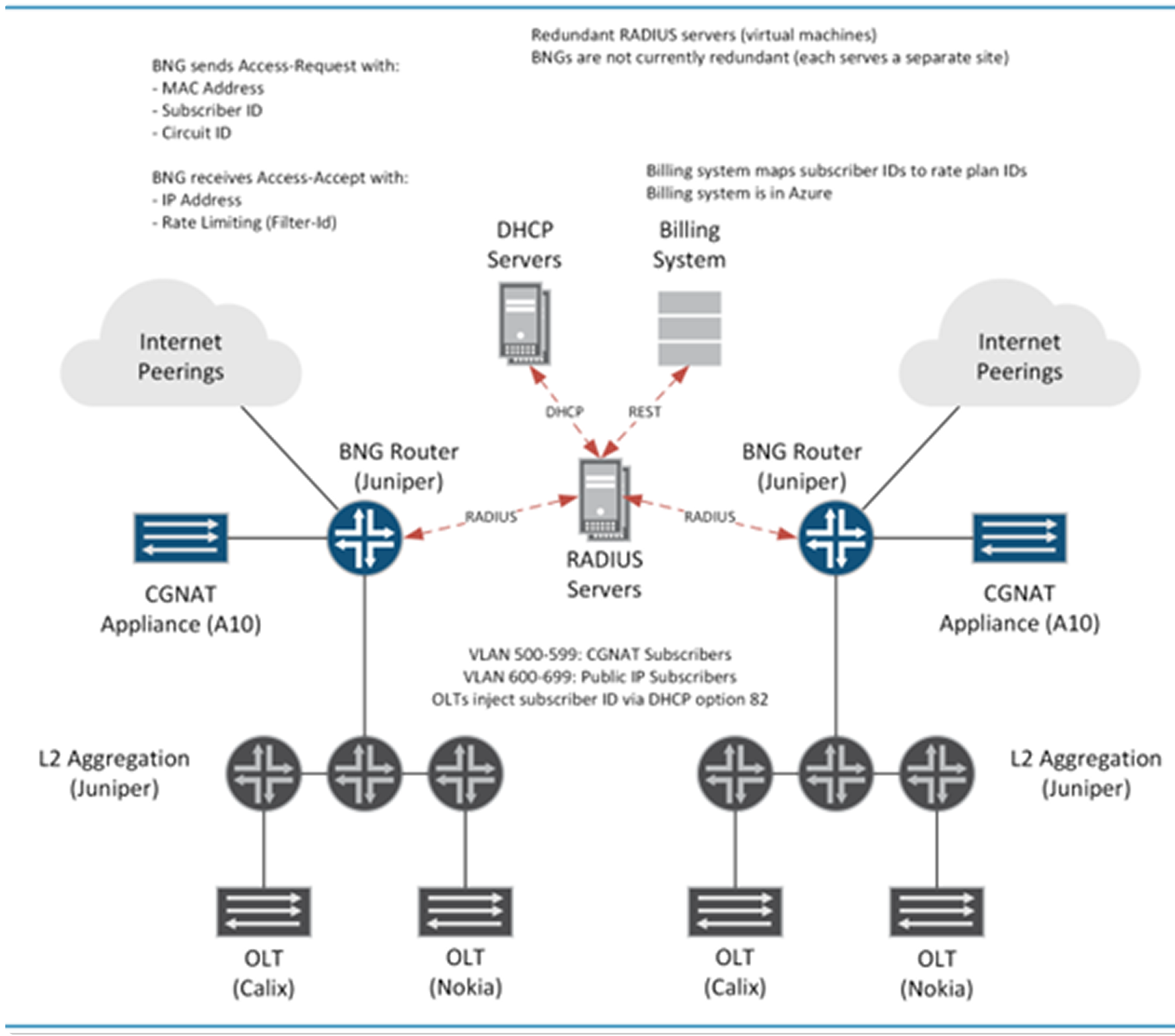
Charter ran discovery across the existing billing, DHCP, and routing systems, including the Smart B/OSS billing platform, the Info blox DDI/DHCP system, and Juniper BNG routers, then ran collaborative design workshops to define how each system would talk to AAA authentication. The team documented the subscriber authentication workflow, built configuration templates for BNG router class-of-service profiles, and set a migration and testing plan before touching production. Charter deployed and configured Radiator AAA software, integrated it with the billing and DDI systems, and validated the build in a lab before cutover. The production deployment ran across two after-hours maintenance windows, with Charter on Day 1 support the business day after go-live.
Outcomes
- Launched on time. Internet, TV, and Voice went live together on an architecture built to work end to end across every domain.
- One team, one result. Charter delivered the engagement as 402.5 hours of coordinated design, build, and deployment, one owner accountable for an outcome that would otherwise have meant managing several specialized vendors separately.
- Lower cost. The overall integration came in below what a multi-vendor, per-technology approach would have cost.
- Resilient by design. Subscriber authentication, billing, and DDI/DHCP were integrated and validated in a lab before cutover, so the service held up for subscribers from day one.
- Supported from day one. Charter provided go-live support the first business day after launch, not a hand-off at cutover.
Capabilities engaged
- Consulting & Business Architecture: the single architecture across every vendor domain.Transformation Roadmapping.
- Project Services: integration of billing, DHCP, routing, and AAA, lab-validated before cutover. Systems Integration, Delivery Management.
- Procurement & Technology Solutions: coordination across multiple manufacturers under one plan. Vendor Management.
- Managed Services / IT Support: Day 1 support after go-live.
One team set the architecture, integrated every vendor, deployed, and supported from Day
- This is the strategy-to-execution model in a single engagement, and the reason the launch held and cost less than a vendor-per-technology approach.
FAQ
Is it better to use one integration partner or a vendor per technology?
For this triple-play launch, one architecture and one accountable team delivered anon-time launch at a cost significantly below a vendor-per-technology approach, and removed the risk of pieces not working as one system at go-live.
What does end-to-end service provider integration include?
On this engagement it covered Internet, TV, and Voice plus billing, subscriber authentication (AAA), DDI/DHCP, and BNG routing, integrated and lab-validated before production cutover.
More Insights



Charter turns your technology into measurable business outcomes. Efficiently, secure, at enterprise scale.
Ready to see what's possible? Find out what Charter can do for you.
Start a conversation
Start a conversation

