Business architecture: converting strategy into executable change.
Why business architecture is the discipline that turns a strategy into a measured roadmap, and Charter's approach.

Olga Laren
Director Business Architecture
·
July, 2026
·
11 min

A more complex operating environment
Business leaders now contend with a convergence of pressures: fragmented and underused data, accumulating technical debt, elevated cyber risk, workforce and skills constraints, the imperative to operationalize AI, and sustained volatility across supply chains and trade. Individually, each strains the organization. Collectively, they obscure a coherent path forward and make it difficult to determine where investment will produce the greatest return.
Business architecture is the discipline that resolves this. It establishes the connective layer between enterprise strategy and technology execution, ensuring that investment decisions trace directly to business priorities. As Suncor's SVP and CIO John Hill has observed, the convergence of business architecture and business technology is now a practical reality rather than a theoretical construct. This article outlines how Charter applies it.
The gap between strategy and execution
Business and technology functions frequently describe the same objective in incompatible terms. A technology organization may frame a priority around infrastructure, a network upgrade to support higher throughput. The business frames the equivalent need operationally, the ability to locate inventory and measure customer traffic in real time. Both articulations are legitimate; neither, in isolation, connects the investment to the outcome it is meant to serve.
Business architecture provides that translation. It begins not with the available technology but with a defined understanding of the organization's governing priorities.
An outcome-led starting point
A technology-led approach reasons from capability to application, from what a platform can do toward a use for it. Business architecture reverses that sequence. It begins with the enterprise's intended future state and works back to the people, process, data, and technology capabilities required to reach it. The discipline operates at the intersection of business priorities, stakeholders, and the systems that run the organization, the point at which strategy becomes executable.
Establishing alignment: the Essentials engagement
Charter's engagements begin with the Business Innovation Essentials workshop, delivered by its enterprise architecture and design thinking practitioners. The workshop combines the client's knowledge of its own markets with Charter's assessment of industry and technology trends to establish strategic alignment before any roadmap is developed.
The planning phase researches the business, evaluates relevant market and technology trends, develops a competitive analysis, maps and interviews stakeholders, and prepares an initial business model canvas. The workshop then reviews the organization's vision, mission, and values against the performance indicators that transformation is intended to move; convenes stakeholders from every affected line of business; and applies a design thinking framework structured around empathy, problem definition, ideation, prototyping, and testing.
The Charter Business Architecture Methodology
CBAM is Charter's structured, repeatable methodology for business architecture. It proceeds through five phases:
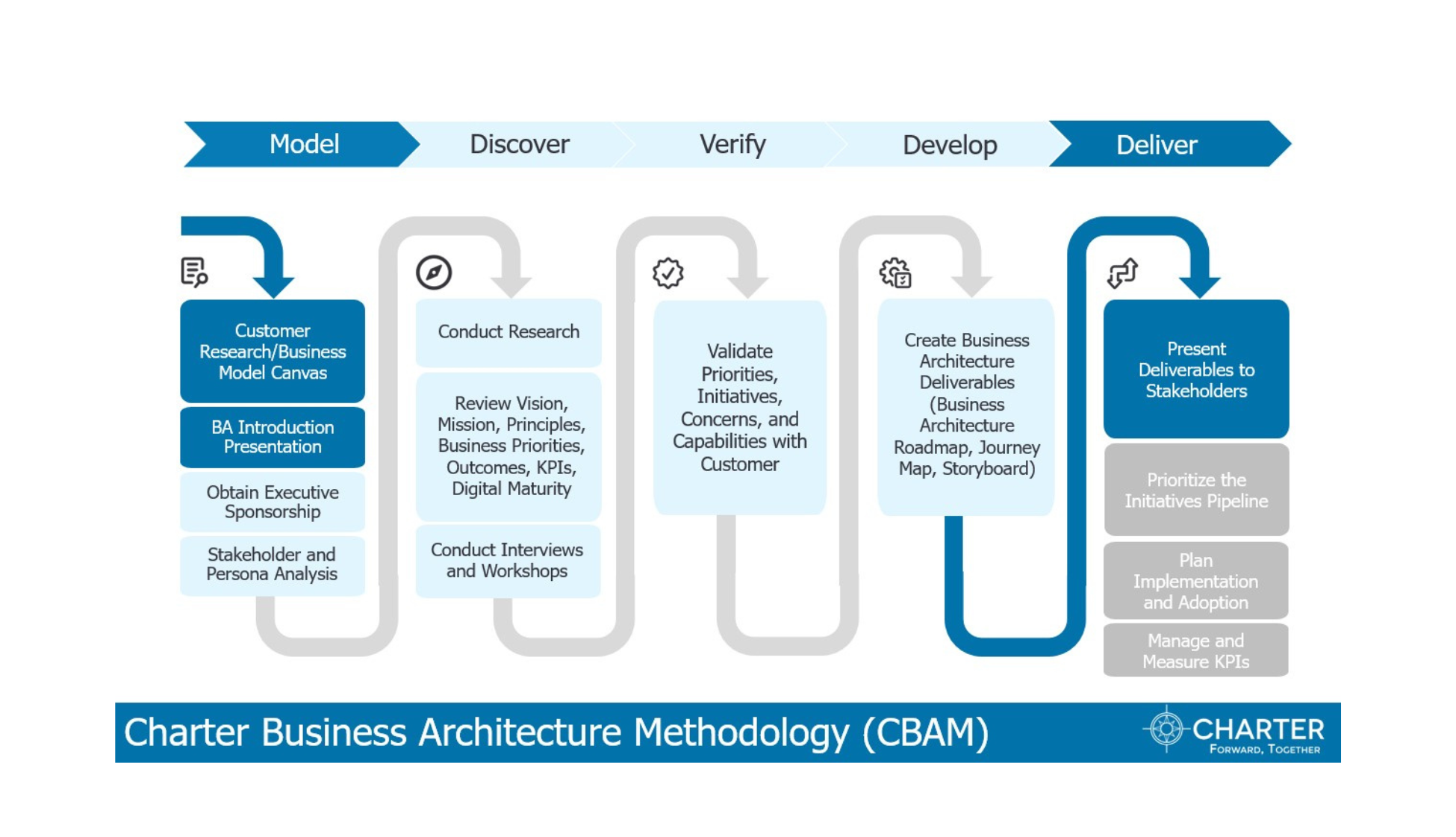
- Model: Customer research and business model canvas, executive sponsorship, and stakeholder and persona analysis establish the scope and mandate of the engagement.
- Discover: Structured interviews and workshops surface the organization's vision, priorities, target outcomes, performance indicators, and current digital maturity.
- Verify: Priorities, initiatives, and required capabilities are validated directly with the client, ensuring the resulting strategy reflects the business rather than an external assumption.
- Develop: The core deliverables are produced: the transformation roadmap, journey maps, and storyboard.
- Deliver: Findings and recommendations are presented to stakeholders, sequenced against the priorities defined at the outset.
The methodology produces a business transformation roadmap that sequences people, process, and technology against enterprise priorities, supported by a storyboard that aligns technology strategy to those priorities.
Data as a first-class input
For a significant share of engagements, data is not a supporting consideration but the substance of the transformation itself. In these cases, the Charter Data Enablement Methodology (CDEM) runs in parallel with CBAM across the same five phases: aligning data strategy with current utilization, assessing current-state governance, validating data management priorities with the client, developing the conceptual data model and recommendations, and defining a prioritized initiatives pipeline with associated performance indicators. Conducting data enablement concurrently ensures that data and business strategy advance together rather than sequentially.
A framework-agnostic approach
Charter applies established frameworks selectively, according to the demands of each engagement. TOGAF governs engagements in which alignment between business and technology architecture is paramount. The DAMA and CDMP data governance frameworks, applied alongside Industry 4.0 principles, address engagements in which data constitutes a core enterprise asset. Design thinking is applied where customer and user value is the primary objective.
Charter's practitioners hold certifications across TOGAF 9, DAMA, the Association of Enterprise Architects, IIBA, ITIL, and IBM's Enterprise Design Thinking program, with sector experience spanning energy, aerospace, healthcare, financial services, and the public sector.
Operationalizing AI
For most organizations, the question of AI adoption has shifted from whether to how, and many remain suspended between experimentation and execution. Business architecture provides the mechanism for closing that distance. Charter's AI work,spanning intelligent automation through to agentic systems, situates AI within a defined model of enterprise priorities and capabilities, rather than applying it to processes that have not been mapped. Positioned this way, AI investment is directed toward measurable enterprise outcomes.
Engagement deliverables
Deliverables are scoped to the engagement and reviewed with the client before the completed set is presented. Two artifacts anchor most engagements:
- A business transformation blueprint: a refined executive summary, problem and opportunity definitions, a transformed business model canvas, up to five personas, and up to two journey maps.
- A prototype: developed to the specific requirement, ranging from a conceptual sketch or diagram to an application wireframe or a structured description of the people, process, and technology involved.
These are supported by persona-level analysis, establishing, for each stakeholder group, what information they require, why it matters, how it will be delivered, and the outcome it is intended to produce. They are also supported by a capability investment model that maps validated priorities to specific investments across cloud infrastructure, ERP, identity management, artificial intelligence, document management, cybersecurity, data analytics, and data governance. Journey maps trace stakeholder experience and critical decision points across each stage, grounding the roadmap in the organization's actual points of friction.
Sector experience and outcomes
Charter has applied the discipline across service providers, healthcare, education, enterprise and industrial organizations, and the public sector, in addition to its own internal transformation. Representative engagements include:
- A global health research institute, for which Charter developed a digital transformation roadmap premised on data as the primary instrument of discovery.
- A territorial government, supported with eService architecture for driver and vehicle licensing and a technical debt assessment across six critical systems.
- An oil and gas enterprise, for which a digital twin, ERP, customer portal, and field application opened new revenue streams.
- A charter aviation operator, provided with a flight operations roadmap incorporating new commercial models for drone services.
- An Indigenous regional corporation, supported with a roadmap aligning IT to the business across applications, data, and community infrastructure.
- An energy security initiative, for which Charter produced an Industry 4.0 reference architecture for the convergence of IT and OT.
- A post-secondary institution, provided with a technology infrastructure strategy and operations master plan.
Charter is a technology solutions integrator established in 1997, operating from seven offices across Canada and serving more than one thousand clients. Its business architecture practice begins not with a technology decision but with a defined understanding of enterprise priorities, and a proven method for converting that understanding into a roadmap leadership can execute.
More Insights



Charter turns your technology into measurable business outcomes. Efficiently, secure, at enterprise scale.
Ready to see what's possible? Find out what Charter can do for you.
Start a conversation
Start a conversation

